Mesozoic Monsters: a whole heap of vertebrate palaeontology, straight from the desk of researchers in the field. This is the title and tagline of my blog. I had every intention – when I started this blog – of regularly updating my readership with little titbits of my research, but I soon learned that it is not that simple and ideas need protecting and publishing first. So this is to be the first article that is submitted in the true spirit of MM.
The newly described Koumpiodontosuchus aprosdokiti Sweetman, Pedreira-Segade and Vidovic 2014 is a small crocodyliforme,
neosuchian, bernissartiid from the Isle of Wight, UK. The specimen was found a
couple years ago on the foreshore of Yaverland beach, Isle of Wight. The
associated sediment suggested that the material had come out of the Wessex
Formation, Wealden Group. The specimen, which is the holotype (type material)
and only specimen of Koumpiodontosuchus
is represented by a skull which was broken in two and found by separate
individuals, but they were married together by some “serendipity” (SCW in
Sweetman et al. 2014). I had the good fortune of working on this specimen, and
I was tasked with placing it in the crocodile evolutionary tree, which I will
discuss further below.
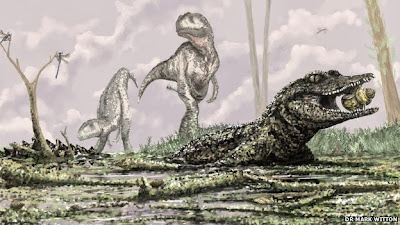 |
| A palaeontological reconstruction of the Wessex Fm. Biota, by Mark Witton, reproduced with his permission. |
Koumpiodontosuchus is a small crocodyliforme at an estimated
66cm in total length – the skull is 11.2cm in length. The dentition is
distinctive and alerted us to the natural affinities of this small croc. It has
a tribodont dentition in the distal portion of the jaw (back of mouth).
Tribodont teeth are bulbous, and kind of onion-shaped. Clearly these teeth are
involved more in digestion rather than prey capture. The mesial teeth (front)
are somewhat procumbent (forward pointing) simple cones, followed by some
pseudo-canine teeth, one of which projected up from the lower jaw and sat in a
notch in the side of the upper jaw, just behind the nares (nostrils). This
morphology is typical of a previously monotypic family (only contained one
genus), the Bernissartiidae Dollo, 1883. Thus, it would be expected that a
cladistic analysis would have no problem placing Koumpiodontosuchus with the type genus of the family Bernissartia fagesii “Known from
contemporaneous strata” (Sweetman et al. 2014) in Belgium and Spain. However,
there are some distinguishing features of Koumpiodontoshuchus
which are not only distinct from Bernissartia,
but also convergent upon Eusuchia. Namely, the position of a perforation named
the choana within the pterygoid bones, which is one of the defining characteristics
of Eusuchia.
 |
| This image is made available by APP through the creative commons licence. Originally produced by UP-S & SCW in Sweetman et al. 2014. |
The specimen was first made public at SVPCA
Oxford, but at that time it became clear – in light of the above convergences –
that there were some unusual features this skull possessed which required
further exploration with cladistic methods, and so I was signed up – hence the
one and a half year hiatus.
The presence of compound characters in cladistic
analyses means that a systematist (someone who performs these analyses) may not
be telling the computer what they believe they are (Brazeau, 2011). As such
character conflict may be artificially high, causing some natural groups to
lack support, while other tentative groups gain support. Due to this and the
chimaera-like situation that Koumpiodontosuchus
found itself in meant that a whole new ‘Brazeau-acceptable’ analysis had to be
constructed, picking and choosing, or altering characters from published
analyses. So, in order to assess the systematic position of Koumpiodontosuchus an analysis coding 36
taxa for 242 characters was run in TNT, using a NT search. The result – after
running more procedures to find the maximum number of MPTs (most parsimonious
[best fitting] trees) – was a strict consensus of 17 trees with a length of 862
steps. A single tree was generated using implied weighting, which is the tree
we finally presented. The logic behind this is that implied weighting changes the
‘impact’ of conflicting characters whilst the analysis runs, thus diminishing
the effects of homoplasy (convergence of characters due to reasons other than a
natural affinity): perfect for this scenario. The result (see cladogram) was
that the Bernissartiidae was found as the sister-group to Rugosuchus, goniopholidids and Eusuchia. Interestingly,
Thalattosuchia – a major group of marine crocodiles (see my article on Dakosaurus) – was found within
Tethysuchia, a grouping that previously contained dyrosaurs and pholidosaurs,
exclusive of thalattosuchians. Worryingly, the presence of the choana within
the pterygoids of Koumpiodontosuchus,
and its placement outside of Eusuchia leaves the clade of ‘true crocodiles’
wanting a definition. Salisbury et al. (2006) were happy to define the clade
based on Isisfordia being the most
basal member of the family, but according to this analysis that would exclude a
lot of traditional Eusuchians. Brochu (1999) thought that Eusuchia could be
defined by the most recent common ancestor of Hylaeochampsa and Crocodylia, but this is also an unreliable
solution due to the shifting position of Hylaeochampsa
between many analyses.
 |
| This image is made available by APP through the creative commons licence. Originally produced by SUV in Sweetman et al. 2014. |
 |
| For any South Park fans. |
References
Brazeau, M. D. 2011. Problematic character
coding methods in morphology and their effects. Biological Journal of the
Linnean Society. 104: 489-498.
Brochu, C. A. 1999. Phylogenetics, taxonomy,
and historical biogeography of Alligatoroidea.
Journal of Vertebrate Paleontology. 19 (sup. 2), 9–100.
Dollo, L. 1883. Premiere note sur les
crocodiliens de Bernissart. Bulletin de l’Institut Royal des Sciences
Naturelles de Belgique 2: 309–338.Salisbury et al. (2006)
Sweetman, S. C.,
Pedreira-Segade, U. and Vidovic, S.U. 2014. A new bernissartiid crocodyliform
from the Lower Cretaceous Wessex Formation (Wealden Group, Barremian) of the
Isle of Wight, southern England. Acta Palaeontologica Polonica. Doixxx


